

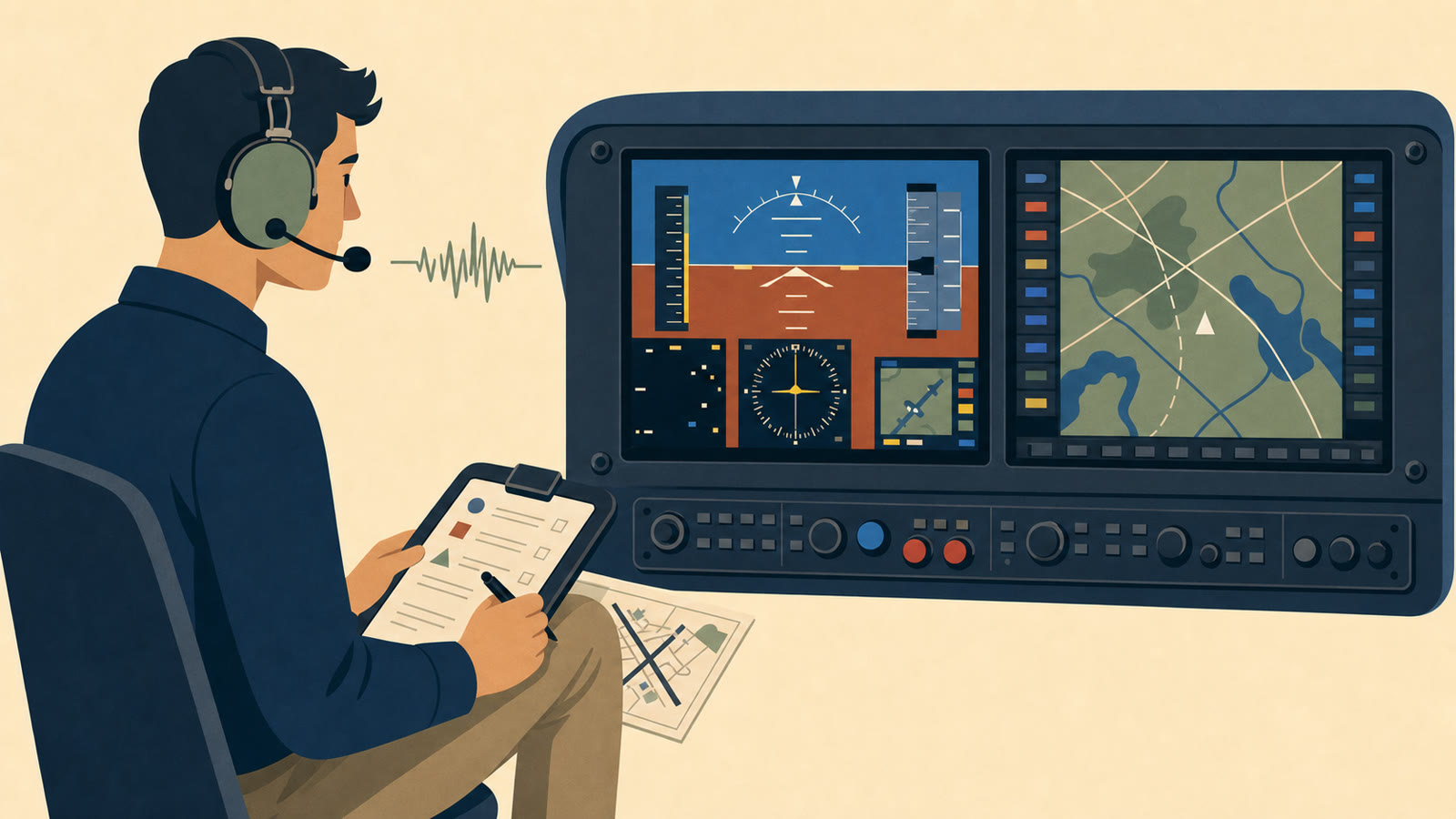
Radio confidence is not memorizing a perfect script. It is recognizing a pattern while the airplane still needs to be flown: listen, determine who was called, extract the instruction, write the critical pieces, answer clearly, then notice when something does not fit. Chair-flying is useful because it gives that loop repetitions before the first busy frequency, but it is rehearsal, not a substitute for instructor feedback or actual radio work.
This is a 14-day, 15-to-25-minute practice plan built for the student who specifically needs more ATC reps before a checkride. Every sample transmission here is practice-only. Real frequencies, runway assignments, taxi routes, traffic, and clearances come from current charts and airport publications, ATIS/AWOS, the controller, and your instructor.
Why ATC Practice Is in the ACS
The current FAA-S-ACS-6C Private Pilot Airplane ACS puts communications inside normal airplane operations, not in a separate “radio” box. In Taxiing, PA.II.D.K2 is “Taxi instructions/clearances,” PA.II.D.K6b is “Radio communications at towered and nontowered airports,” and PA.II.D.R2 addresses “Confirmation or expectation bias as related to taxi instructions.” The associated skills are PA.II.D.S1, “Receive and correctly read back clearances/instructions, if applicable”; PA.II.D.S2, “Use an airport diagram or taxi chart during taxi, if published, and maintain situational awareness”; and PA.II.D.S7, “Comply with airport/taxiway markings, signals, and air traffic control (ATC) clearances and instructions.”
Task PA.III.A, Communications, Light Signals, and Runway Lighting Systems, is even more direct. PA.III.A.K1 is how to obtain appropriate radio frequencies; PA.III.A.K2, proper radio communication procedures and ATC phraseology; PA.III.A.K3, light signals; PA.III.A.K4, transponder use; PA.III.A.K5, lost communications; PA.III.A.K6, equipment issues that can cause loss of communication; and PA.III.A.K7, radar assistance. Its risk elements include PA.III.A.R1, “Communication,” and PA.III.A.R4, “Use of non-standard phraseology.” Its skills require you to select and activate appropriate frequencies (PA.III.A.S1), transmit with standard AIM and Pilot/Controller Glossary phraseology and procedures (PA.III.A.S2), and acknowledge communications and comply with ATC instructions or evaluator direction (PA.III.A.S3) (FAA-S-ACS-6C).
Traffic pattern work raises the stakes. PA.III.B covers towered and nontowered operations, current weather and airport information, and right-of-way. Its risk elements identify collision hazards and distractions, task prioritization, loss of situational awareness, or disorientation; S6 requires situational awareness and proper spacing from other aircraft in the pattern. Navigation adds PA.VI.B.K3, radar assistance to VFR aircraft, and PA.VI.B.S6, proper communication while using radar services. If lost, PA.VI.D.K2 addresses available assistance and PA.VI.D.S4 requires using navigation systems/facilities or contacting ATC. Finally, PA.VIII.F, Radio Communications, Navigation Systems/Facilities, and Radar Services, requires in S1 airplane control while selecting frequencies, identifying the facility, and managing navigation equipment (FAA-S-ACS-6C). That is the standard: communicate accurately without allowing the radio to take over your attention. In a dual-screen G1000 trainer, chair-fly selecting and verifying COM frequencies using the aircraft’s current avionics guide and your instructor’s procedures. Practice keeping radio setup from pulling your attention into the PFD or MFD and away from airplane control and traffic scanning.
The ATC Loop: Listen, Identify, Capture, Build, Transmit, Verify
Use this six-step loop as an original chair-flying framework. It is not an FAA mnemonic. The goal is to make the same mental sequence automatic whether the call is easy or busy.
- Listen. Do not key up just because you have a call prepared. AIM 4-2-2 says to listen before transmitting; after a frequency change, pause, listen, and make sure the frequency is clear. Monitoring may also answer the question you were about to ask (AIM 4-2-2).
- Identify. Match the entire call sign before acting. AIM 4-2-4 warns that improper call signs can lead a pilot to execute another aircraft’s clearance and says aircraft identification must be complete and clearly identified before action (AIM 4-2-4).
- Capture. Write the pieces that vanish first: runway, taxi route, hold-short point, heading, altitude, frequency, squawk, and any restriction. Put an airport diagram under the pencil for taxi work.
- Build. Decide what must be acknowledged or read back, then make one concise response. Do not add an essay, an apology, or invented words.
- Transmit. Speak at a normal pace. Press, pause a beat, speak clearly, release. A rushed call is harder to understand and harder to correct.
- Verify. If the instruction, call sign, or route does not make sense, stop the chain. AIM 4-2-4 gives the exact recovery: “VERIFY CLEARANCE FOR (your complete call sign)” (AIM 4-2-4).
Readback Priorities: Practice What Can Move the Airplane
Pilots should acknowledge callups or clearances unless told otherwise, and should acknowledge a frequency change rather than silently selecting it (AIM 4-2-3). For chair-flying, give extra repetitions to runway assignments, hold-short instructions, headings, altitudes, frequencies, squawk codes, and route or taxi instructions. These are high-value items to capture and correctly read back, not a claimed universal regulatory readback list. Follow the controller’s direction and the practices your instructor teaches for the operation at hand.
A good kneeboard shorthand is deliberately boring: RWY / TAXI / HS / HDG / ALT / FREQ / SQK. If a clearance arrives faster than you can write it, say so and request repetition rather than guessing. The Pilot/Controller Glossary defines “SAY AGAIN” as a pilot request to repeat the last transmission and “UNABLE” as inability to comply with a specific instruction, request, or clearance (Pilot/Controller Glossary).
The 14-Day ATC Practice Plan
Use a chair, headset or handheld mic, kneeboard, current airport diagram, and timer. Say the calls aloud. Each day is short enough to repeat after a flight lesson; the pass standard is a training target, not an FAA test standard.
Days 1-4: Build the Basic Call
- Day 1: Call signs and numbers, 15 minutes. Objective: say your registration, phonetic alphabet, runway numbers, altitudes, and frequencies cleanly. Setup: make 20 cards with numbers and call signs. Drill: alternate full call sign on initial contact and an abbreviated form only after a controller has initiated it. Pass: 18 of 20 cards correct without speeding up.
- Day 2: Initial calls, 20 minutes. Objective: build one call with facility, full identification, position, and request. Setup: use blank facility and position cards. Drill: speak 10 initial calls, then listen to your recording. Pass: all four information blocks present, no filler.
- Day 3: ATIS/AWOS capture, 20 minutes. Objective: copy an information broadcast and make one clean request. Setup: use a current, instructor-provided recording or written practice sheet. Drill: write identifier, wind, runway information, and items your instructor expects you to retain; then state the received identifier in the request. Pass: no invented weather or runway data.
- Day 4: Taxi and hold-short traps, 25 minutes. Objective: trace clearances on an airport diagram. Setup: choose a current published diagram. Drill: script 10 taxi routes that include an explicit hold-short point; trace before answering. Pass: route and hold-short location are both correct on 9 of 10.
Days 5-8: Runway and Pattern Work
- Day 5: Tower departure, 20 minutes. Objective: keep runway, clearance, and frequency changes separate. Setup: make cards for a generic departure sequence. Drill: capture and read back each item, then point to the runway on the diagram before the simulated lineup or takeoff. Pass: zero runway mismatches.
- Day 6: Pattern sequencing, 20 minutes. Objective: understand tower sequencing without losing the traffic picture. Setup: draw a runway and three traffic symbols. Drill: answer practice instructions such as extend downwind or number two, then describe where the traffic is and your spacing plan. “TRAFFIC IN SIGHT” informs a controller that previously issued traffic is in sight; “NEGATIVE CONTACT” informs ATC that previously issued traffic is not in sight and may be followed by a request for help avoiding it. Report traffic in sight only after truthful visual acquisition (Pilot/Controller Glossary). Pass: every response includes your call sign and preserves visual scanning.
- Day 7: Nontowered CTAF, 20 minutes. Objective: self-announce positions and intentions, not conversations. Setup: current airport publication and diagram. Drill: rehearse taxi, departure, 10-mile arrival, and pattern calls. AC 90-66B says to use the correct airport name at the beginning and end of each self-announce and not to use “any traffic in the area, please advise” (AC 90-66B). Pass: every call states call sign, position or operation, intention, and airport name.
- Day 8: Arrival, landing, and go-around, 20 minutes. Objective: react to a landing clearance, changing traffic, or a go-around without freezing. Setup: runway diagram and five scenario cards. Drill: identify runway, read back as applicable, then rehearse a concise go-around call and continued scanning. Pass: you never treat a landing clearance as permission to ignore a runway conflict.
Days 9-12: Services and Recovery
- Day 9: Flight following, 20 minutes. Objective: organize a request for radar services. Setup: write a generic information structure: who you are, aircraft type/call sign, position, altitude, destination, and request. Drill: make five versions without creating facility-specific wording. Pass: the request is concise and the basic facts are complete; expect ATC to determine what service is available.
- Day 10: Rapid capture, 15 minutes. Objective: write and read back heading, altitude, frequency, and squawk. Setup: 25 mixed instruction cards. Drill: show a card for three seconds, capture it, then transmit the response. Pass: 22 of 25 complete and accurate.
- Day 11: Recovery language, 20 minutes. Objective: replace bluffing with a prompt recovery. Setup: cards marked missed, unclear, unable, unfamiliar, or similar call sign. Drill: use “SAY AGAIN,” “VERIFY CLEARANCE FOR [full call sign],” or “UNABLE” as appropriate. Request progressive taxi if unfamiliar or confused; the PCG defines it as precise taxi instructions for a pilot unfamiliar with the airport or in adverse conditions. “STAND BY” means the controller or pilot must pause for a few seconds, usually for higher-priority duties; if the delay is lengthy, the caller should reestablish contact. It does not mean approval or denial (Pilot/Controller Glossary). A student may identify as a student pilot on initial contact to receive additional assistance (AIM 4-2-4). Pass: recovery starts within five seconds, never with fake understanding.
- Day 12: Lost and communications problems, 25 minutes. Objective: ask for assistance early and keep flying. Setup: current chart, lost-procedures notes, and light-signal reference. Drill: narrate airplane control, position uncertainty, available navigation, and a concise request for ATC help; then study light signals from the current AIM. Pass: you can state what you would do next without claiming chair-flying alone prepares you for a real malfunction.
Days 13-14: Put the Whole Flight Together
- Day 13: Full towered flow, 25 minutes. Objective: link every phase from engine start through shutdown. Setup: current KAPA-style diagram only, but use placeholders. Drill: work the practice-only scenario below with [ATIS], [Ground], [Tower], Runway XX, and Taxiway A. Pass: no action occurs before listening, identifying, and tracing.
- Day 14: Full nontowered flow, 25 minutes. Objective: integrate CTAF calls with traffic scanning. Setup: current KLVJ-style diagram and current CTAF placeholder. Drill: work the practice-only scenario below from startup through departure, return, pattern, landing, and shutdown. Pass: correct airport name first and last, current-publication CTAF, and a visual scan stated before every turning point.
Solo Drill Methods That Actually Create Reps
Script both sides. Write a controller or instructor line on one card and the pilot response on the reverse, then randomize instruction types. Start audio playback slowly, pause and verbalize before answering, then repeat at normal speed. Record yourself. The recording reveals swallowed call signs, forgotten frequencies, and the habit of answering before the instruction is fully heard.
For the last five minutes, add a safe parallel task at home: trace a taxi route, point to a chart symbol, work a simple checklist while handling a call, or point to the active and standby COM locations on a printed dual-screen G1000 panel image while simulating a frequency swap. It simulates divided attention without introducing distractions in flight. Never create a deliberate distraction while operating an airplane. Real ATC recordings and videos can be recognition practice only, never authority for phraseology. LiveATC is an optional third-party listening tool; availability and legality vary by location, and recordings can contain real-world shorthand or errors. Use the AIM and PCG as the authority.
Score each response 0 or 1: accuracy, completeness, call sign, sequence, brevity, correction/recovery, and situational awareness. Seven points is clean; five or below means repeat the card and write what was missed. A score measures a rehearsal, not legal or operational proficiency.
Practice-Only Scenario 1: Towered Airport
This is illustrative only. It does not represent KAPA frequencies, runways, routes, or local procedures. Use current publications, ATIS/AWOS, ATC instructions, and instructor guidance for any actual operation.
- Pilot setup: Complete the engine-start and before-taxi flow in accordance with the aircraft POH and local ramp procedures. Listen to [ATIS], copy the identifier, then monitor [Ground].
- Controller: “[Practice aircraft], [Ground], runway XX, taxi via Taxiway A, hold short of Runway YY.”
- Pilot: “[Ground], [full call sign], taxi Runway XX via Taxiway A, hold short of Runway YY.” The pilot traces A and marks the hold-short point.
- Controller: “[Abbreviated call sign], contact [Tower].”
- Pilot on current frequency: “Contact [Tower], [abbreviated call sign].”
- Pilot after switching: Select [Tower], listen first, then make an appropriate initial call using the facility name, identification, position, and a short request or status as applicable.
- Pilot mistake: Another aircraft with a similar call sign receives a runway instruction. The pilot starts to move.
- Pilot recovery: Stop. “VERIFY CLEARANCE FOR [full call sign].” Do not move until identity and instruction are clear.
- Controller: “[Full call sign], cleared for the option Runway XX.”
- Pilot: “[Full call sign], cleared for the option Runway XX.” Continue scanning, maintain airplane control, and comply only with the actual clearance.
- Pilot return: On the return, get current [ATIS], contact the appropriate facility when directed, and capture the assigned runway, sequence, and any instruction. After landing, do not cross or taxi until the actual instruction is understood; trace the route to parking on the diagram.
- Pilot shutdown: At parking, complete the shutdown flow using the POH and local procedures. Replay the whole sequence and mark where a missed call would have required a clarification.
Practice-Only Scenario 2: Nontowered Airport
This is illustrative only. It does not represent KLVJ CTAF, runway use, winds, traffic, or local procedures. AC 90-66B directs pilots to use the published CTAF, monitor and communicate as appropriate, and be especially vigilant for traffic because not every aircraft is radio equipped (AC 90-66B).
- Pilot: “[Airport Name] traffic, [aircraft type and call sign], taxiing from [specific ramp or location] to Runway XX, [Airport Name].” Use the current CTAF from current airport information.
- Pilot: “[Airport Name] traffic, [full call sign], departing Runway XX, remaining in the pattern, [Airport Name].” Look outside before entering or crossing any runway.
- Traffic: “[Airport Name] traffic, [other aircraft], left downwind Runway XX, [Airport Name].”
- Pilot mistake: The student says, “Any traffic please advise.”
- Pilot recovery: Replace it with an actual position-and-intention call: “[Airport Name] traffic, [full call sign], five miles [direction] of the airport, planning entry to the pattern for Runway XX, [Airport Name].” Continue scanning; a call is not a traffic-clearance system.
- Pilot: “[Airport Name] traffic, [aircraft type and call sign], clear of Runway XX, [Airport Name].” Continue monitoring and communicating as appropriate through taxi and until clear of the movement area.
Use This on the Checkride
A DPE can evaluate communications through scenario questions and actual radio work, within the ACS tasks and conditions. Do not expect one fixed script or one mandatory examiner style. Be ready to explain how you obtain a frequency, identify a clearance for your airplane, request help if uncertain, use radar services, respond to being lost, and keep control while changing frequencies. Then demonstrate the same habits when the radio is live (FAA-S-ACS-6C).
48-hour tune-up: Two days before, do Days 4, 10, and 11 once each. The day before, chair-fly one full towered or nontowered route using current publications with your instructor, then stop. On checkride morning, review recovery phrases, diagram orientation, and the rule that a missed transmission is a reason to ask, not a reason to guess.
Oral self-test: What must you confirm before acting on a clearance? What would you write from this taxi instruction? Where is the hold-short point? How do you ask for a repeat? What does “unable” communicate? When might you identify yourself as a student pilot? How would you request ATC help if uncertain of position? Answer each from the ACS, AIM, PCG, current chart data, and your instructor’s guidance rather than from memory alone.
Bottom Line
Practice transmissions, but more importantly practice listening, extracting, complying, and recovering. The student who can say a rehearsed departure call but cannot identify the correct call sign, trace a taxi clearance, or admit confusion still has the dangerous part left to learn.
Run the loop for 15 to 25 minutes a day: listen, identify, capture, build, transmit, verify. Bring the scorecard to your CFI, use current information for every real flight, and let real radio work turn the rehearsal into skill. The goal is not to sound like a controller. The goal is to understand, communicate, and keep flying the airplane.